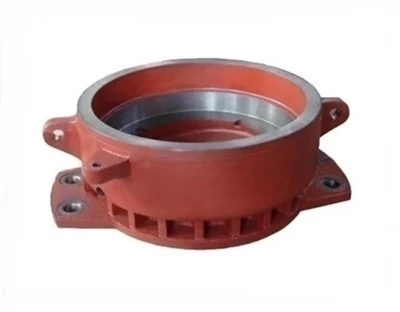
Tips for using engineering machinery castings
Apr 15, 2025
Tips for using engineering machinery castings mainly include the following aspects:
Choose the right casting process: In large or giant products such as engineering machinery, mining machinery, agricultural machinery, industrial equipment and aerospace, casting can replace machining, forging, stamping and other processes, thereby reducing costs. Whether it is feasible depends on factors such as the geometry of the metal parts, welding length, number of parts, dimensional stability, appearance, defect rate, mechanical properties and product batch. For example, parts with complex geometries and multiple parts are more suitable for casting, which can reduce assembly costs and transportation costs.
Optimize design to reduce welding processes: Through design optimization, multiple small parts can be combined into one part, reducing or even eliminating welding processes, thereby reducing costs. For example, a structural part on a heavy truck was originally welded from 17 parts, and was combined into one part through casting, reducing costs by 43%.
Choose the right material: Gray cast iron is often used for large equipment parts such as bases and bed frames due to its good thermal flow properties and strong shock absorption capabilities. During the design, attention should be paid to the linear shrinkage rate and notch sensitivity of the material to ensure that the casting has good comprehensive mechanical properties.
Detailed processing of the casting process: During the casting process, attention should be paid to uniform wall thickness and smooth transition, avoiding abrupt folding edges or corners, and using larger arc transitions to reduce casting stress and processing stress. In addition, the parting surface and lifting holes should be reasonably set to ensure gas discharge and waste sand cleaning during the casting process.
Handling casting defects: Porosity, cold shock and other defects may occur during the casting process, which need to be controlled by methods such as open pouring system, tilted pouring and setting overflow water inlet. For thick solid castings, such as flywheel castings, special attention should be paid to the control of shrinkage defects, which can be supplemented by means of riser caulking and adding chilled iron.